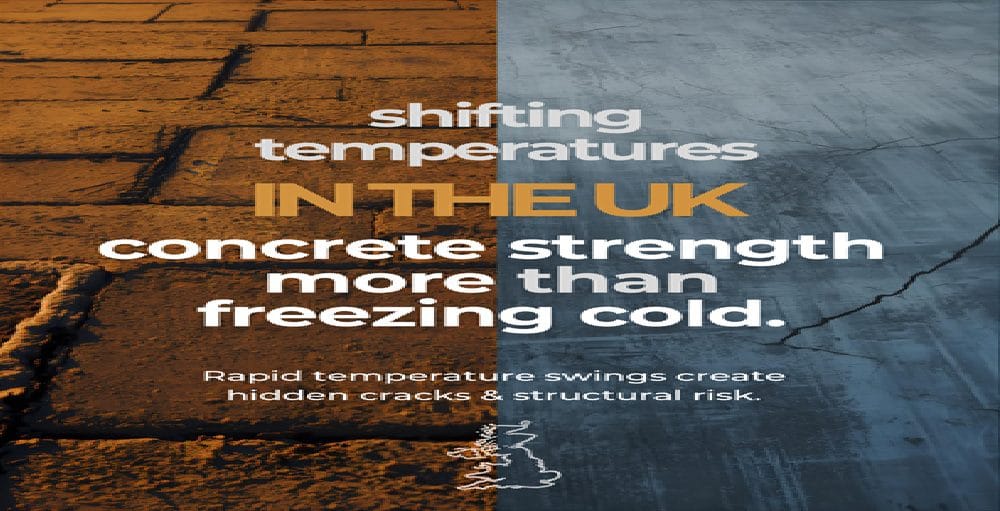
Summer concrete failure in the UK is often misunderstood. Many homeowners assume warmer weather improves curing. In reality, heat introduces risks that directly affect strength, surface quality, and long-term durability. Concrete poured during summer conditions in the UK reacts faster than intended, which reduces control over how the material hardens.
Concrete strength depends on the moisture remaining within the mix long enough for proper bonding to occur. During warm weather, evaporation increases soon after placement. This alters curing behaviour and exposes the slab to uneven internal stress. The temperature effect on concrete is therefore linked to moisture loss during the early hours, not extreme heat alone.
As a result, concrete that feels firm at first can still develop hidden weaknesses if the mix design and curing methods are not adapted for summer conditions.
How Heat Reforms Strength Development In Fresh Concrete
Concrete gains strength through a controlled chemical process that requires time and moisture. Summer heat accelerates surface drying but does not speed up internal strength development at the same rate. This imbalance creates stress within the slab structure.
In practical terms, warm conditions reduce available working time. The surface stiffens earlier, which limits finishing control. Meanwhile, deeper layers remain softer for longer. This uneven hardening reduces durability, particularly for exposed domestic surfaces such as driveways, paths, and patios.
Key performance changes during summer pours include:
- Shortened finishing windows
- Uneven curing between the surface and the base
- Increased internal stress within the slab
- Reduced tolerance to long-term load and wear
These effects explain why many summer-related concrete failures appear months after installation rather than immediately.
Why Fast Drying Creates Structural And Surface Problems
Fast-drying concrete problems occur when surface moisture escapes faster than it can be replaced from within the mix. The surface shrinks while the lower concrete remains stable, which leads to cracking that weakens the top layer.
These cracks are structural, not cosmetic. They reduce resistance to abrasion, allow moisture penetration, and increase vulnerability to freeze–thaw cycles later in the year. Once water enters these weak points, deterioration accelerates.
Typical outcomes of uncontrolled fast drying include:
- Early surface cracking
- Reduced surface density
- Weak edges and joints
- Lower resistance to weather exposure
These failures develop during the first few hours after pouring, which is why prevention must happen before placement rather than after defects appear.
Why Hot Weather Concrete Needs Planned Mix Control
Hot weather concrete cannot rely on standard mix behaviour. Summer pours require adjustments that manage moisture retention and setting speed. Without this control, curing becomes inconsistent and unpredictable.
A weather-resistant concrete mix is designed to slow surface moisture loss while maintaining workable consistency. This allows strength to develop evenly across the slab depth and provides sufficient time for accurate placement and finishing.
Planned summer mixes help achieve:
- Balanced curing throughout the slab
- Reduced surface stress during early stages
- Improved final strength and durability
- More consistent visual finish
This is not an optional upgrade. It is a practical requirement for achieving reliable performance during UK summer pours.
Why Timing And Supply Matter During Summer Pours
Mix design alone does not protect concrete during warm weather. Summer pours also depend on precise delivery timing. Delays increase exposure to heat and wind, which intensifies moisture loss before placement begins.
Mighty Concrete operates as a local supplier supporting domestic projects across St Albans, Twickenham, Watford, Wembley, Windsor, and Wokingham, along with nearby areas. This local coverage allows summer pours to be scheduled within tighter delivery windows, reducing time between batching and placement.
When controlled mix design and reliable delivery timing work together, heat-related risks are reduced significantly.
Best Practices For Pouring Concrete During UK Summer Conditions
Summer concrete work requires planning rather than speed. Pouring at unsuitable times or without protection increases moisture loss and weakens results. Preparation, therefore, plays a central role in summer success.
Early morning pours help limit heat exposure. Shaded working areas reduce surface temperature. Immediate curing protection helps retain moisture during the most critical early curing phase.
Effective summer pouring practices include:
- Pouring during cooler parts of the day
- Shielding fresh concrete from direct sunlight
- Limiting wind exposure across the slab
- Applying curing protection immediately after finishing
These steps support steady strength development and reduce surface stress during warm periods.
Why Weather-Resistant Concrete Mixes Matter In Summer
Standard mixes are designed for moderate conditions. Summer heat alters how concrete behaves during placement and curing. A weather-resistant concrete mix manages this change by controlling moisture movement and setting speed.
These mixes promote steady curing rather than rapid surface drying. As a result, the slab gains strength evenly from top to base, which reduces cracking, surface weakness, and long-term wear.
Key advantages include:
- Controlled moisture retention
- Improved workability in warm conditions
- Reduced risk of early surface damage
- Stronger long-term performance
For homeowners, the benefit is clear. Proper mix design reduces the likelihood of future repairs caused by heat-related damage.
How Delivery Timing Influences Summer Concrete Quality
Concrete quality depends on how quickly it reaches the pour location. During summer, delays expose the mix to heat and wind before placement, which reduces workability and increases drying risk.
Mighty Concrete provides same-day and next-day delivery across St Albans, Twickenham, Watford, Wembley, Windsor, and Wokingham, along with surrounding areas. Shorter delivery times limit heat exposure and help maintain consistent placement conditions.
When delivery timing aligns with summer-ready mix design, concrete performance remains reliable even during warm weather.
How Mighty Concrete Supports Summer-Ready Concrete Projects
Many summer concrete issues begin before the pour starts. Mix selection, delivery coordination, and site readiness all influence outcomes. Mighty Concrete supports homeowners by focusing on these decisions early rather than reacting after problems develop.
Mighty Concrete provides you:
- Guidance on selecting summer-appropriate mixes
- Coordinated delivery to limit heat exposure
- Reliable batching for consistent quality
- Practical advice on warm-weather placement
This approach helps homeowners avoid common summer failures while keeping projects predictable and manageable.
Avoiding Costly Repairs Linked To Summer Heat Damage
Heat-related concrete damage rarely appears straight away. Cracks, surface wear, and strength loss often develop months later, when repairs become disruptive and expensive.
Summer-related failures often result in:
- Early resurfacing or patch repairs
- Reduced the lifespan of driveways and slabs
- Moisture penetration during colder months
- Ongoing maintenance costs
Preventing these issues starts with correct planning. A balanced mix and controlled curing protect concrete from seasonal stress and reduce long-term expense.
Build Stronger Concrete Even During the UK Summer Heat
Summer heat places concrete under stress from the moment it is poured. Rapid moisture loss, uneven curing, and surface shrinkage weaken results when mix design is ignored. However, these risks are avoidable with the right preparation.
Working with concrete in summer UK conditions requires controlled curing, thoughtful timing, and a weather-resistant concrete mix designed to manage heat. When these elements work together, concrete gains strength steadily and performs as intended over time.
Protect your concrete from heat damage with a balanced, weather-resistant mix. For reliable supply, expert guidance, and flexible summer delivery, contact Mighty Concrete on 01753 900066 or reach the team via WhatsApp to discuss your project.
FAQs
- Does summer heat really weaken concrete in the UK?
Yes. Heat increases moisture loss, which affects curing and long-term strength when not managed properly. - What are the most common summer concrete problems?
Surface cracking, weak finishes, and reduced durability caused by fast drying. - How does mix design help during hot weather?
A controlled mix manages moisture loss and setting speed, which improves strength and finish. - Is it better to pour concrete early in the day during summer?
Yes. Cooler conditions reduce evaporation and support more consistent curing.