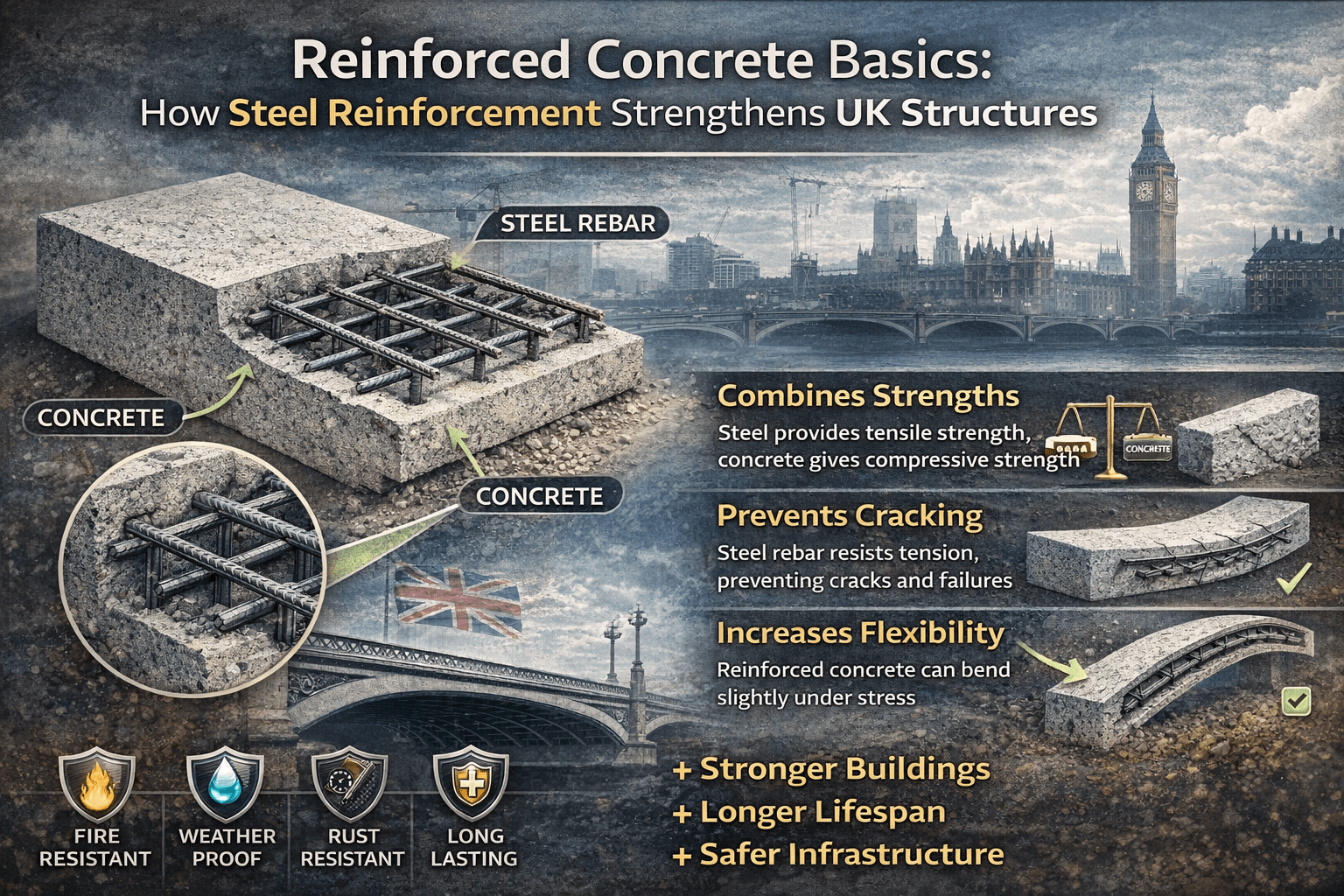
Concrete forms the backbone of many modern structures. However, plain concrete alone cannot handle every structural demand. While it performs very well under compression, it remains weak when tension or bending forces appear. Therefore, engineers and builders rely on reinforced concrete in the UK to create structures that remain strong, stable, and durable over time.
Steel bars placed within the concrete help overcome this limitation. Known as steel rebar concrete reinforcement, these bars absorb tensile forces and prevent structural cracking. As a result, buildings gain greater durability and improved load capacity. Additionally, structural reinforcement plays a critical role in foundations, slabs, and beams.
In the sections ahead, we explain how load-bearing concrete becomes far stronger with reinforced foundations and properly designed reinforcement systems.
What Is Reinforced Concrete And How Does It Work?
Reinforced concrete is a combination of concrete and steel reinforcement. Together, these materials create a composite structure that performs better than either material alone.
Concrete handles compressive forces well. Steel reinforcement, on the other hand, resists tension and bending. When combined, they form steel rebar concrete systems capable of carrying complex structural loads.
Additionally, this partnership allows structures to perform well under daily stress. Roads, houses, and bridges all rely on this principle. Therefore, reinforced concrete in the UK remains one of the most widely used construction materials.
Key features of reinforced systems include:
- Steel bars absorb tensile stress within the concrete
- Concrete protects steel from environmental exposure
- Reinforcement distributes loads across the structure
- Structural movement remains controlled under pressure
Consequently, reinforced concrete becomes far stronger than plain concrete. This is why engineers depend on load-bearing concrete systems for critical structural components.
Why Structural Reinforcement Is Necessary for Load-Bearing Concrete
Concrete alone cannot resist tension effectively. When bending forces appear, cracks may develop. However, structural reinforcement prevents this problem by supporting the tension within the structure.
Steel bars embedded in concrete carry these forces safely. Therefore, reinforced systems reduce cracking and protect structural stability.
Several important benefits result from reinforcement:
- Increased tensile strength within the structure
- Better resistance to bending and flexural stress
- Reduced crack formation in load-bearing concrete
- Longer structural lifespan
Additionally, reinforcement improves performance in foundations. Reinforced foundations distribute weight evenly across the soil. As a result, buildings maintain stability even when ground conditions change slightly.
Meanwhile, reinforced slabs and beams manage heavy loads without sudden failure. This is why structural engineers specify reinforcement in nearly every modern project.
How Steel Rebar Concrete Improves Structural Strength
Steel reinforcement works effectively inside concrete due to its physical design. Rebar bars contain ridges along their surface. These ridges create a strong mechanical bond with the surrounding concrete.
Consequently, both materials move together when loads act on the structure. This shared behaviour ensures that steel rebar concrete systems operate as a single structural unit.
Several factors strengthen reinforced concrete:
- Ribbed steel bars improve bonding with concrete
- Reinforcement carries tensile stress within structural elements
- Concrete absorbs compressive loads efficiently
- Load transfer occurs evenly throughout the structure
Additionally, reinforced systems perform well under changing temperatures. Steel and concrete expand at nearly identical rates. Therefore, the bond between them remains stable in typical UK conditions.
Where Reinforced Concrete Is Commonly Used In UK Construction
Reinforced concrete supports many essential structural elements. Domestic construction relies heavily on reinforced systems for strength and durability.
Common applications include:
- Reinforced foundations supporting residential buildings
- Structural beams and columns carrying vertical loads
- Concrete slabs form floors and driveways
- Bridge decks supporting traffic loads
Similarly, reinforced concrete helps buildings resist environmental stress. Heavy rainfall, temperature changes, and ground movement all place pressure on structures. Reinforcement allows load-bearing concrete to manage these forces effectively.
Structural Reinforcement In Local Construction Projects
Construction activity continues across towns such as Guildford, Harrow, Hemel Hempstead, Henley-on-Thames, High Wycombe, and Langley. Projects in these areas often rely on reinforced structural systems for durability and stability.
A local supplier serving these regions supports residential and small commercial construction with dependable material delivery. Such suppliers help ensure projects receive consistent concrete supply when reinforcement work begins.
Mighty Concrete operates as a regional supplier across Guildford, Harrow, Hemel Hempstead, Henley on Thames, High Wycombe, and Langley. With same-day and next-day delivery services, it helps builders and homeowners obtain a reliable concrete supply for reinforced structural work.
This dependable supply supports the installation of steel rebar concrete systems, reinforced slabs, and stable foundations across domestic construction projects.
Key Factors Engineers Consider When Designing Reinforced Concrete
Structural engineers plan reinforcement carefully. Every reinforced element must handle expected loads while maintaining durability over time.
Several factors guide reinforcement design:
- The type and size of steel rebar used in concrete
- Spacing between reinforcement bars
- Concrete cover protecting steel reinforcement
- Load requirements for the structural element
- Environmental exposure, such as moisture or temperature variation
Additionally, reinforcement must remain positioned correctly within the concrete. Proper spacing ensures the concrete bonds effectively with the steel bars. Therefore, engineers design reinforcement layouts before concrete placement begins.
Furthermore, sustainability now plays a role in structural design. Many reinforcement products contain recycled steel. Consequently, modern structural reinforcement contributes to environmentally responsible construction across the UK.
Problems That Occur When Concrete Lacks Reinforcement
Plain concrete may appear strong. However, it cannot resist tensile stress effectively. Therefore, structures without reinforcement often develop problems over time.
Common issues include:
- Cracking in slabs or foundations
- Weak load distribution in structural elements
- Reduced lifespan of concrete structures
- Increased maintenance or repair costs
Additionally, structural movement can worsen these problems. When buildings experience bending forces or ground movement, reinforcement stabilises the structure. Without steel reinforcement, the concrete may fracture under stress.
Therefore, engineers rely on reinforced concrete in the UK to maintain reliable structural performance.
Why Reinforced Concrete Remains Essential For Modern Construction
Modern buildings must handle heavy loads, environmental changes, and long service lifespans. Reinforcement helps concrete meet these demands.
Steel bars strengthen load-bearing concrete while maintaining structural flexibility. Additionally, reinforcement prevents sudden structural failure when loads increase.
Key advantages include:
- Improved tensile strength within structural elements
- Reduced cracking under bending forces
- Longer service life for buildings and infrastructure
- Greater stability in reinforced foundations
Consequently, reinforced concrete continues to support residential development, infrastructure projects, and structural engineering across the UK.
Build Stronger Structures With Properly Reinforced Concrete
Reliable structures depend on materials that perform well under real construction conditions. Reinforced concrete in the UK provides this reliability by combining concrete strength with steel reinforcement. When steel rebar concrete systems are installed correctly, buildings gain improved durability, greater load capacity, and stronger resistance to cracking.
Furthermore, structural reinforcement ensures that load-bearing concrete elements perform safely under pressure. This is why engineers rely on reinforced foundations to stabilise homes, extensions, and structural slabs.
For dependable concrete supply supporting reinforced construction projects, Mighty Concrete provides affordable and reliable services across Guildford, Harrow, Hemel Hempstead, Henley on Thames, High Wycombe, Langley, and nearby areas.
To strengthen your next project with properly reinforced concrete, contact Mighty Concrete on 01753 900066 or reach the team via WhatsApp for quick assistance and delivery booking.
FAQs
- Why Is Reinforced Concrete Used In Construction?
Reinforced concrete combines concrete and steel reinforcement. This combination allows structures to resist both compression and tension forces. - What Does Steel Rebar Do Inside Concrete?
Steel bars carry tensile forces that concrete alone cannot handle. This prevents cracking and strengthens structural elements. - Where Are Reinforced Foundations Used In Homes?
Reinforced foundations support load-bearing walls, extensions, structural slabs, and other key residential building components. - Does Reinforced Concrete Last Longer Than Plain Concrete?
Yes. Reinforcement improves durability and helps structures resist cracking, bending, and heavy loads over time.