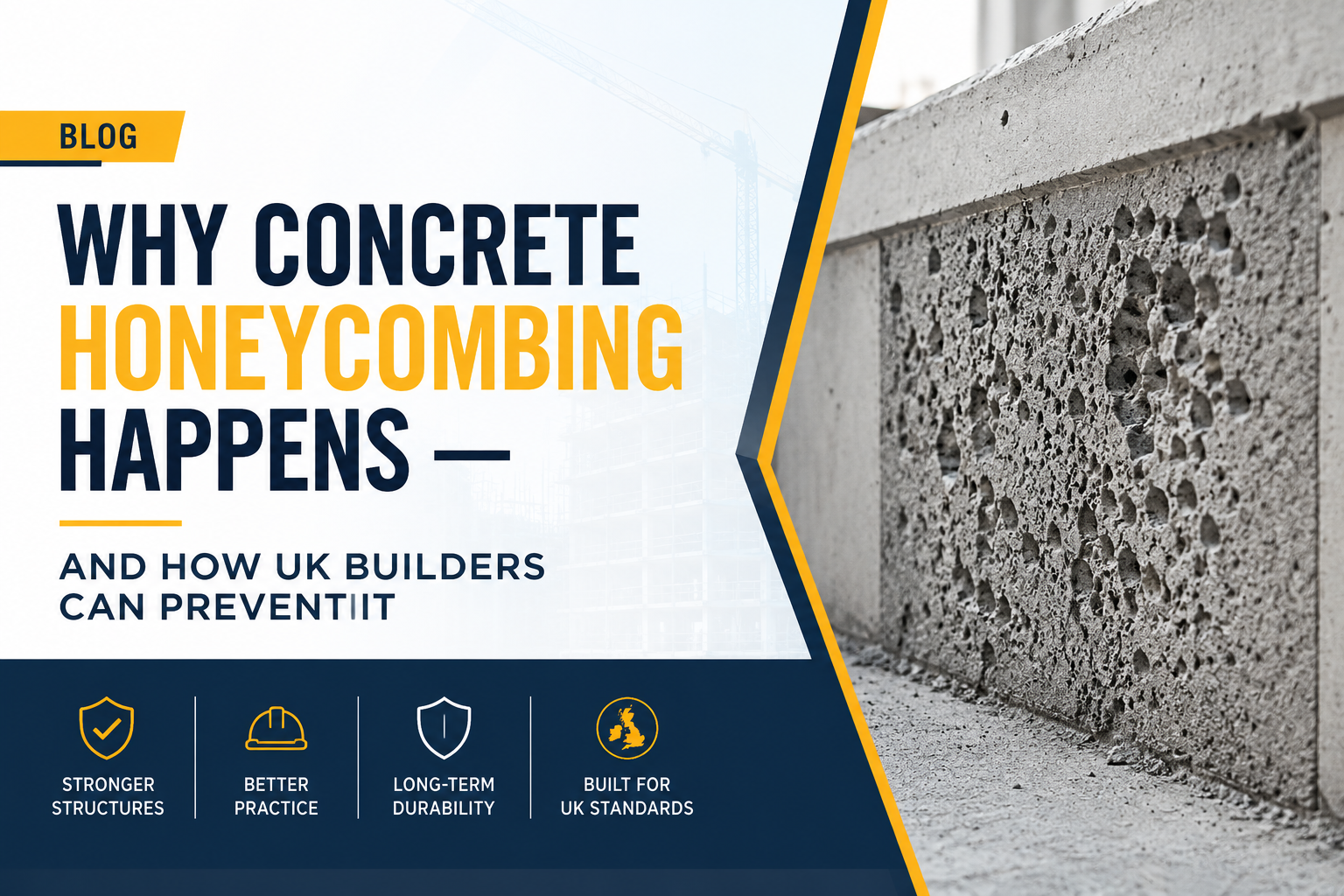
Concrete honeycombing in the UK is a serious construction defect. The problem creates rough cavities, exposed aggregates, and visible voids in concrete. In many UK projects, honeycombing appears after formwork removal. As a result, the finished concrete looks weak and uneven.
Most honeycombing defects start during poor concrete placement. Weak compaction, stiff concrete mixes, and leaking formwork often create trapped air pockets inside the structure. In addition, congested reinforcement can stop concrete from flowing properly. Therefore, builders must focus on strong concrete defect prevention methods during every stage of placement.
Across foundations, walls, slabs, and reinforced columns, honeycombing can reduce durability and increase repair costs. Therefore, UK builders should understand the causes early and prevent structural defects before they spread.
What Does Concrete Honeycombing Look Like?
Concrete honeycombing looks like empty gaps inside hardened concrete. Usually, the surface exposes large stones and rough cavities. As a result, the concrete appears patchy and poorly compacted.
Most defects become visible after removing the shuttering or formwork. In severe cases, reinforcement bars may also become exposed. Therefore, early inspection is important on every construction site.
Common Signs Of Concrete Honeycombing
| Visible Defect | What The Problem Means |
| Rough cavities | Concrete failed to compact fully |
| Exposed aggregates | The cement paste did not fill the gaps |
| Air pockets | Trapped air remained inside the structure |
| Weak corners | Concrete flow was poor near the edges |
| Exposed reinforcement | Structural protection may reduce |
On many UK sites, honeycombing appears near beam-column joints and congested reinforcement zones. These areas are harder to compact correctly during pouring.
Why Does Concrete Honeycombing Happen?
Concrete honeycombing happens when fresh concrete fails to flow and compact correctly. In most cases, trapped air and weak placement methods create empty spaces inside the structure. Therefore, builders should monitor pouring, vibration, and formwork conditions carefully.
Inadequate Vibration
Poor vibration is one of the biggest causes of voids in concrete. If workers fail to compact the mix fully, trapped air stays inside the structure. As a result, cavities appear after the concrete hardens.
However, excessive vibration also creates problems. Heavy aggregates may sink while the cement paste rises upward. Therefore, segregation can weaken the concrete further.
Problems Linked To Poor Vibration
- Trapped air pockets inside the concrete
- Weak bonding near reinforcement bars
- Uneven concrete density
- Surface honeycombing defects
On busy UK sites, rushed vibration work often creates defects near corners and reinforcement joints. Therefore, builders should compact concrete slowly and evenly.
Poor Mix Workability
Concrete must flow easily around reinforcement and inside formwork. However, stiff mixes struggle to reach tight sections properly. As a result, gaps and cavities often remain inside the structure.
Cold weather can also reduce workability quickly. Across Reading, Slough, and Southampton, winter often pours more stiffly during colder mornings. Therefore, builders should monitor concrete flow carefully during low temperatures.
Poor Workability Often Causes
- Incomplete concrete filling
- Rough surface cavities
- Weak structural consistency
- Greater risk of concrete honeycombing in the UK
Most contractors improve workability using correct water-cement ratios and superplasticisers. This method improves flow without weakening the mix.
Reinforcement Congestion
Closely packed reinforcement blocks aggregate movement during placement. Therefore, larger stones often become trapped between steel bars while the cement paste flows through alone.
This problem creates visible voids in concrete around reinforcement zones. In reinforced concrete structures, these gaps may later allow moisture to reach the steel.
Reinforcement Congestion May Lead To
- Poor aggregate distribution
- Weak concrete density
- Honeycombed reinforcement zones
- Long-term durability issues
On reinforced columns and deep beams, builders should maintain enough spacing for proper concrete flow and compaction.
Leaking Formwork
Leaking formwork removes cement slurry during pouring. As a result, exposed aggregates remain behind while the concrete loses binding material.
Poorly sealed shuttering is a common issue on fast-moving projects. Therefore, builders should inspect joints and edges carefully before pouring begins.
Problems Caused By Leaking Formwork
- Cement paste loss
- Weak surface strength
- Rough concrete patches
- Lower durability levels
Watertight formwork improves finish quality and reduces future honeycombed concrete repair work.
Excessive Pour Heights
Concrete should not fall from excessive heights during placement. Otherwise, heavier aggregates separate from the cement paste before settling.
This separation creates weak zones and uneven density inside the structure. Therefore, controlled placement methods are essential during deeper pours.
Excessive Pour Heights Often Create
- Aggregate separation
- Weak lower concrete sections
- Internal cavities
- Higher honeycombing risk
Builders often use tremie pipes and chutes during large pours. These tools guide concrete safely and improve placement control.
Why Are Voids In Concrete A Structural Problem?
Voids in concrete weaken structural strength and long-term durability. In many cases, moisture enters through porous sections and reaches the reinforcement steel. As a result, corrosion risks increase over time.
UK weather conditions can worsen the damage further. During winter, freeze-thaw cycles often expand weak concrete sections and increase cracking. Therefore, builders should repair honeycombing defects quickly.
Structural Problems Linked To Honeycombing
| Structural Issue | Impact On The Structure |
| Reduced strength | Concrete carries less structural load |
| Moisture penetration | Water enters porous concrete easily |
| Reinforcement corrosion | Steel bars may rust over time |
| Lower durability | Concrete deteriorates faster |
| Higher repair costs | Structural repairs become more expensive |
In severe cases, structural engineers may need to inspect the damaged section before loading continues safely.
How Can UK Builders Prevent Concrete Honeycombing?
UK builders can prevent concrete honeycombing in the UK through proper planning, correct compaction, and controlled placement methods. In most projects, careful preparation reduces the risk of structural defects significantly.
Strong placement practices also improve durability, surface quality, and long-term structural performance. Therefore, prevention is always more cost-effective than repair work later.
Improve Concrete Workability
Concrete should flow smoothly through reinforcement and inside the formwork. Therefore, builders must choose a mix that matches the structure and weather conditions.
Good workability helps:
- Reduce trapped air pockets
- Improve compaction quality
- Lower poor concrete placement risks
- Improve concrete density
Across colder UK regions, concrete can stiffen faster during winter mornings. Therefore, contractors often use superplasticisers to maintain proper flow without adding excess water.
Use Correct Vibration Methods
Correct vibration removes trapped air and improves concrete compaction. However, workers must use the equipment evenly across the structure.
Good Vibration Practices Include
| Vibration Method | Why It Helps |
| Vibrate in thin layers | Improves even compaction |
| Insert vertically | Removes trapped air effectively |
| Maintain regular spacing | Prevents weak concrete zones |
| Remove slowly | Reduces internal cavities |
On reinforced walls and columns, slow and controlled vibration improves density around steel reinforcement.
Control Pour Heights
Builders should avoid dropping concrete from excessive heights. Otherwise, aggregates may separate from the cement paste during placement.
Controlled pouring helps:
- Prevent segregation
- Improve aggregate distribution
- Reduce surface cavities
- Improve structural consistency
For deep foundations and reinforced sections, tremie pipes and chutes improve placement accuracy significantly.
Seal Formwork Properly
Builders should inspect formwork joints before pouring starts. Tight shuttering prevents slurry leakage and improves concrete consistency.
Well-sealed formwork helps prevent:
- Cement paste loss
- Weak surface areas
- Exposed aggregate patches
- Uneven structural density
In many UK groundwork projects, poor shuttering creates avoidable honeycombed concrete repair costs later.
Maintain Correct Reinforcement Spacing
Concrete must move freely between reinforcement bars during placement. Therefore, reinforcement layouts should allow enough space for aggregate flow and vibration access.
Correct spacing improves:
- Concrete movement
- Aggregate distribution
- Compaction quality
- Long-term durability
This method also strengthens overall concrete defect prevention across reinforced concrete structures.
What Is The Best Method For Honeycombed Concrete Repair?
The best repair method depends on the size and depth of the defect. Small honeycombed areas usually need surface repair only. However, larger structural cavities may require engineering assessment and specialist repair methods.
Fast honeycombed concrete repair helps reduce moisture penetration and further structural damage. Therefore, builders should repair defects quickly after inspection.
Common Honeycombed Concrete Repair Methods
| Repair Method | Purpose |
| Remove loose concrete | Clears weak material fully |
| Clean the damaged section | Improves repair bonding |
| Apply polymer mortar | Repairs shallow cavities |
| Use non-shrink grout | Fills deeper structural voids |
| Structural assessment | Checks severe concrete damage |
Builders should never cover honeycombed sections without removing loose material first. Otherwise, repair failure becomes more likely later.
For deeper voids in concrete, structural engineers may recommend pressure grouting or reinforcement strengthening methods.
Reliable Concrete Supply Across Key UK Areas
Construction projects across Reading, Ruislip, Slough, Southampton, Staines, and Swindon depend on reliable material supply and proper site coordination. Therefore, builders should choose suppliers that support consistent mix quality and dependable delivery schedules.
Mighty Concrete provides same-day and next-day delivery services across these locations and nearby areas. In addition, the company supplies affordable and reliable concrete for domestic, commercial, and groundwork projects.
Serving Reading, Ruislip, Slough, Southampton, Staines, and Swindon, Mighty Concrete supports projects that require controlled concrete placement and reliable mix consistency. As a result, builders reduce the risk of poor concrete placement and improve overall structural quality.
Across busy UK construction sites, proper delivery timing also helps contractors manage vibration and placement more effectively during active pours.
Prevent Costly Structural Defects With Better Concrete Placement
Concrete honeycombing in the UK remains one of the most common structural defects on construction sites. However, builders can prevent most honeycombing problems through correct placement, proper vibration, and controlled pouring methods.
Weak compaction, poor workability, and leaking formwork often create hidden voids in concrete. As a result, structures may lose strength, durability, and moisture resistance over time. Therefore, builders should focus on strong concrete defect prevention methods from the beginning of every project.
Fast identification and proper honeycombed concrete repair also reduces long-term structural damage and expensive repair costs later. In addition, reliable concrete supply improves placement control and site efficiency.
Mighty Concrete supports projects across Reading, Ruislip, Slough, Southampton, Staines, and Swindon with dependable service and reliable concrete delivery.
Call or WhatsApp 01753 900066 to prevent costly structural defects with properly placed and compacted concrete.
FAQs
What Causes Concrete Honeycombing On UK Construction Sites?
Poor vibration, stiff concrete mixes, leaking formwork, and incorrect pouring methods commonly cause concrete honeycombing in the UK.
Can Honeycombed Concrete Be Repaired Successfully?
Yes. Small defects often need polymer mortar or grout repairs. However, more serious structural damage may require engineering assessment.
Can Poor Vibration Create Voids In Concrete?
Yes. Weak compaction traps air inside fresh concrete. As a result, visible voids in concrete appear after hardening.
How Can Builders Prevent Concrete Honeycombing?
Builders should improve concrete workability, control pouring methods, compact concrete correctly, and seal formwork properly during placement.